September 17, 2026
Rather than focusing exclusively on attracting foreign investment, Angola must take greater risks, develop innovative strategies for external investment, increase its dividends, and reinvest domestically.
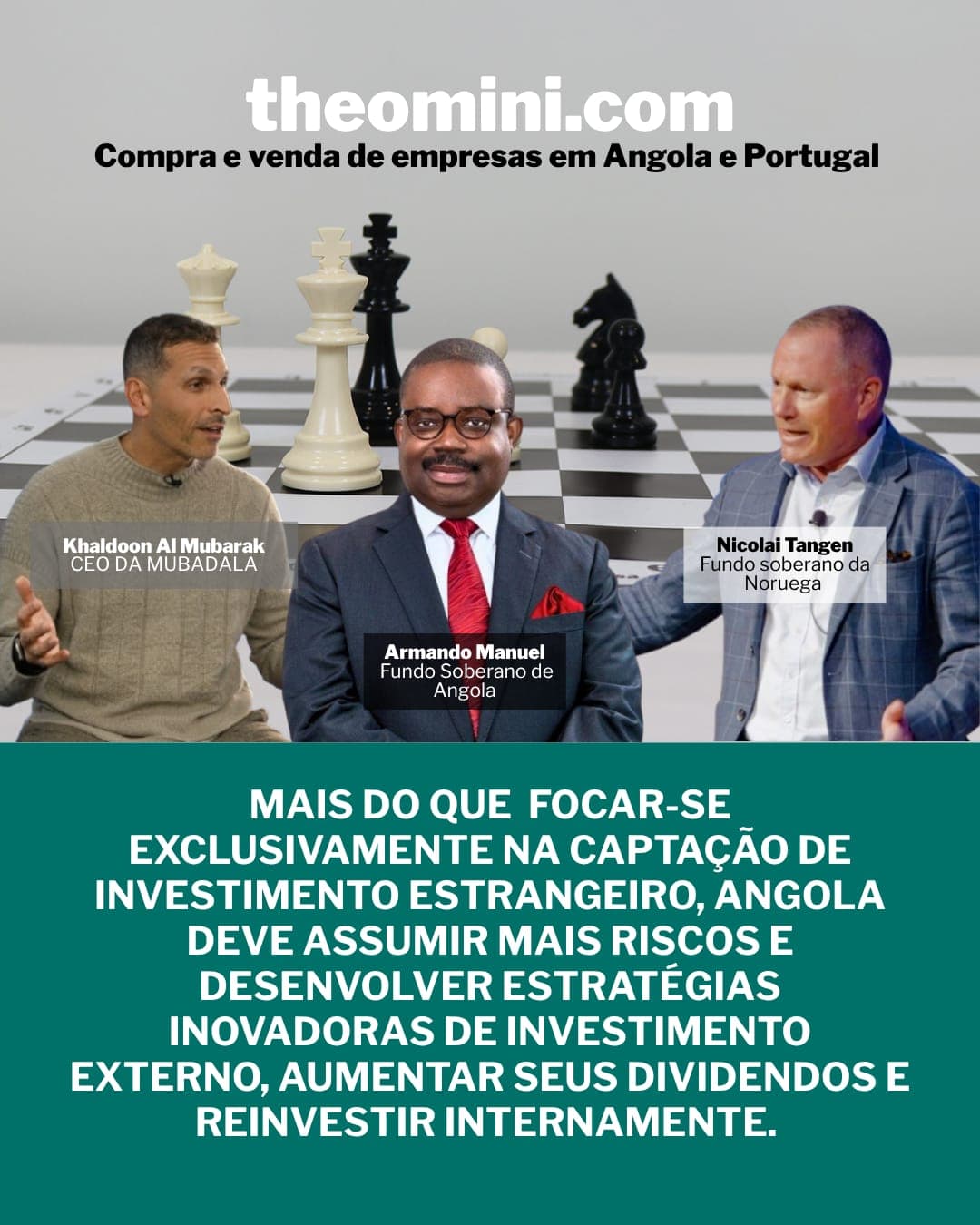
Rather than focusing exclusively on attracting foreign investment, Angola must take on more risk and develop innovative external investment strategies, increase its dividend income, and reinvest domestically. This statement is not mere rhetoric; it is a diagnosis of economic maturity. Countries that have transformed natural resource wealth into intergenerational prosperity did not simply open their doors to foreign capital; they created sophisticated mechanisms to place their own capital in high-quality international assets, generating dividend flows and capital gains that flow back into the domestic economy.
Establishing such mechanisms—specifically public and private funds, investment vehicles, partnerships, and private equity or co-investment structures—is the missing link in Angola’s financial architecture. Without them, the country continues to export opportunities while importing—almost exclusively—both capital and risk.
Parallels with Abu Dhabi’s Mubadala and Norway’s Sovereign Wealth Fund
Abu Dhabi’s Mubadala Investment Company illustrates the path forward. Originally created as a tool for economic diversification, it has evolved into a global sovereign investor managing approximately $385 billion. It operates in over 80 countries, combining direct investments in private markets, endowment-style platforms, and GP-led structures, while allocating capital to high-growth sectors such as technology, healthcare, infrastructure, renewable energy, and private credit. Its mandate is clear: to generate sustainable returns for the shareholder (the Government of Abu Dhabi) while simultaneously building national champions and establishing a global presence.
Historical comparison: Norway versus Angola
The Sovereign Wealth Fund of Angola (FSDEA) was established by presidential decree in 2011 and officially launched in 2012 with an initial endowment of $5 billion derived from oil revenues. At the time, it positioned itself as one of the largest sovereign wealth funds in Sub-Saharan Africa. Plans also included annual capitalization equivalent to the sale of 100,000 barrels of oil per day.
Its trajectory, however, diverged from Norway's. While the GPFG grew consistently through regular contributions, investment discipline, and compounded returns, the FSDEA suffered capital depletion (approximately $2.5 billion between 2018 and 2020) and faced governance and performance challenges. It currently manages a volume significantly lower than its initial capital. The difference lies not only in the initial size (the Norwegian fund started much smaller) but also in strategic consistency, management independence, global risk allocation, and the rule against consuming the principal capital.
Norway transformed commodities into global financial capital. Angola created the instrument but has not yet converted it into the engine for intergenerational wealth accumulation that was intended.
An analysis of the expansion of Chinese sovereign wealth funds
China offers another example of scale and coordinated ambition. The China Investment Corporation (CIC), founded in 2007 with initial capital of $200 billion (funded by the issuance of government bonds), has grown to hold over $1.3 trillion in assets. The CIC and other vehicles linked to China's foreign exchange reserves (including SAFE structures) have become key investors in private equity, infrastructure, and publicly traded companies. They have participated in landmark deals with institutions such as Blackstone, Morgan Stanley, and European and American buyout funds, and have established co-investment platforms with global managers. The objective was clear: to diversify reserves, acquire knowledge, and position Chinese capital at the heart of major global corporations. Even with recent geopolitical restrictions, the rationale behind the overseas allocation of sovereign capital remains intact.